
Introduction:
Etsy seller fees can look small on paper, but on a $100 sale, they can still shave off a real chunk of your margin. Here’s the thing: Etsy’s fee structure in the U.S. includes a $0.20 listing fee, a 6.5% transaction fee, and a 3% plus $0.25 payment processing fee, so the base cost adds up faster than many new sellers expect. If the order comes through Offsite Ads, the total cut can jump again. That is why smart sellers watch their profit margin closely, especially for digital products, where every dollar matters.
This guide will cover the fee stack, digital products, hidden charges, off-site ad impact, an eBay comparison, a simple calculator method, and profit protection. It is built for readers who need answers fast, not a wall of vague advice.
1: What Etsy seller fees mean in the USA
In the U.S., Etsy’s fee structure is straightforward on paper, but the total can still surprise new sellers. The core charges are the listing fee, transaction fee, and payment processing fee. Etsy also adds advertising fees in some cases, and the transaction fee applies to the item price plus shipping and gift wrap, while sales tax is not included in the U.S. transaction fee base. That detail matters because many sellers misread their payout and blame the wrong line item.
Listing fee, transaction fee, and payment processing fee are the three charges every seller should memorize. Etsy’s listing fee is $0.20 per listing. The transaction fee is 6.5% of the total order amount, and the payment processing fee is 3% plus $0.25 in the U.S. Etsy’s own sell page lists those fees clearly, which is useful because it keeps the math anchored to official policy instead of rumor.
Optional fees and conditional fees sit on top of the basics. Etsy Ads use a cost-per-click model, and Offsite Ads charge only when a sale is attributed to one of those ads. That is why the Etsy fee structure content should separate mandatory fees from ad-related fees. When readers see the difference, the numbers no longer feel random.
Why USA sellers need a separate breakdown is because the U.S. payment processing rate and tax treatment are not the same as those in every other country. Etsy’s own U.S. sell page and fee pages make that clear. If you sell from the U.S., you should not copy a global fee example and assume it fits your shop.
2: How much Etsy takes from a $100 sale
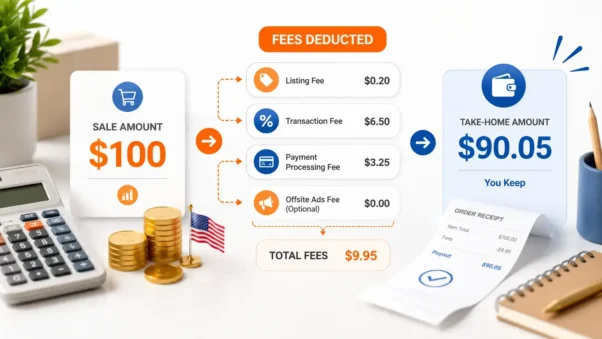
For a plain $100 U.S. sale with no shipping and no sales tax, Etsy’s basic charges come out to about $9.95. That is $0.20 for the listing, $6.50 for the 6.5% transaction fee, and $3.25 for the payment processing fee. Your take-home amount before product cost is then about $90.05. That is the cleanest answer to how much does take from a $100 sale when the sale is organic and uncomplicated.
When shipping or tax enters the picture, the math changes a little. Etsy says the transaction fee applies to the total order amount, which includes shipping and gift wrap, but not U.S. sales tax. The payment processing fee also applies to the item’s total sale price, including shipping fees and any applicable sales tax. That is why the same product can produce a different payout depending on how the order is structured.
| Scenario | Etsy fees | Offsite Ads | Total Etsy take | Net before product cost |
| Organic sale | $9.95 | $0.00 | $9.95 | $90.05 |
| Offsite Ads, shop under $10k | $9.95 | $15.00 | $24.95 | $75.05 |
| Offsite Ads, shop $10k+ | $9.95 | $12.00 | $21.95 | $78.05 |
That table is the real eye-opener. One ad-driven sale can turn a healthy margin into a skinny one very fast. The core Etsy fees stay the same, but the Etsy Offsite Ads fee can slice deep into profit. Etsy says the fee is 15% for shops under $10,000 in trailing 365-day sales and 12% for shops at or above that threshold, with a $100 cap per attributed order.
3: Etsy seller fees for digital products
Etsy seller fees for digital products work much like physical product fees at the marketplace level, which is the point many sellers miss. A digital download does not need shipping, but it still sits inside Etsy’s listing and transaction system, so the same core costs still apply. That means digital sellers do not escape the fee stack; they just remove shipping from the picture.
Why digital downloads still pay core Etsy fees is easy to understand once you look at the fee rules. Etsy charges a listing fee when you publish a listing and a transaction fee when the item sells. The payment processing fee also applies to Etsy Payments orders. So whether you sell a printable, a planner file, a spreadsheet product, or a premium digital bundle, the platform still takes its cut.
Instant downloads versus made-to-order digital files matter for workflow, not for fee avoidance. Etsy’s digital listings help article shows that sellers can choose Digital files or made-to-order digital listings, but the fee structure remains the same idea, a listing goes live, then a sale triggers the order fee stack. That is why smart sellers track Etsy digital download fees before they launch.
Common profit mistakes digital sellers make usually come from low pricing, not high traffic. A low-ticket product can look easy to sell, but the margin often gets thin after fees and discounting. In practice, that is where AOV, bundles, and a realistic break-even price matter more than raw views. The best Etsy seller fees for digital products strategy is to sell value, not just file count.
4: Etsy seller fees USA, fee breakdown by type
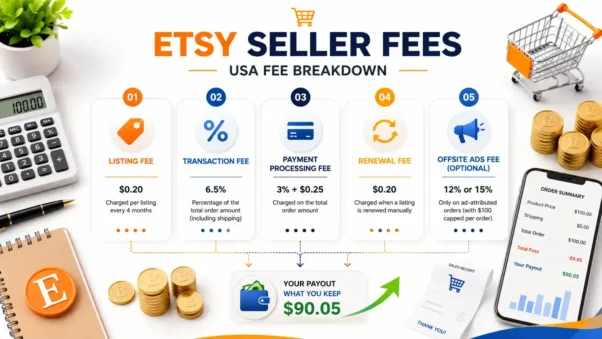
The easiest way to understand Etsy seller fees in the USA is to separate the charges one by one. The Etsy listing fee is the entry cost. Etsy’s transaction fee is the commission on the sale. Etsy payment processing fee covers payment handling. Then you may also see renewal charges, currency conversion fees in certain cases, and ad-related fees if you promote or get attributed traffic. That is the real Etsy fee breakdown.
The listing fee is $0.20 per listing and lasts for four months unless the item sells first. If the listing renews, Etsy charges another $0.20. That sounds tiny, but it adds up if you churn through many products or let weak listings auto-renew without enough sales. For a digital shop with dozens of low-ticket listings, the renewal charge is a quiet margin leak.
The transaction fee is where many sellers feel the sting because it is based on the order total. Etsy says the 6.5% fee applies to the total order amount, including shipping and gift wrap. The payment processing fee is separate and applies to the total sale price, including shipping and any applicable sales tax or VAT, which is why a small order can still feel expensive after fees.
5: Offsite Ads and the real profit impact
This is the part that changes the whole conversation. Etsy’s offsite ads fee is not a tiny side note. It can become the largest fee on the page if the sale is attributed to an off-site ad. Etsy says the rate is 15% for shops under $10,000 in trailing 365-day sales and 12% for shops that reach or exceed that level, and the fee is capped at $100 per attributed order.
How the 15% and 12% fees work is straightforward once you see the trigger. If a buyer clicks an Etsy ad off the platform and buys within the attribution window, Etsy charges the fee on the order total. That is why an organic $100 sale and an ad-driven $100 sale do not feel anything alike in your payout. The ad-driven sale carries a different cost structure, even though the sticker price is the same.
When Offsite Ads become mandatory depends on your shop’s history. Etsy’s policy says shops below the threshold may opt out, while shops that reach the threshold are subject to the program rules. That matters because many newer sellers can control the exposure, but larger shops often have to absorb the fee or build it into pricing.
How Offsite Ads can shrink margin fast is easiest to see with a real example. If a digital product sells for $100 and the order is attributed to Offsite Ads, the fee can jump from $9.95 to $24.95 or $21.95. That is the difference between a strong margin and a weak one. My opinion is simple, if a product cannot survive the free stack, it is priced too low for paid traffic.
6: Etsy seller fees vs eBay fees
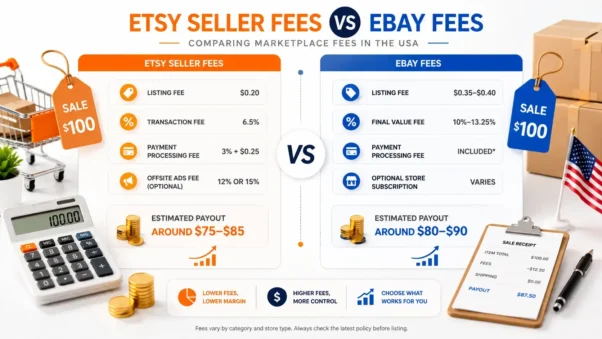
The search term” Etsy seller fees vs eBay fees usually comes from one question: “Which platform keeps more of my money?” eBay’s current fee page says sellers pay one final value fee when an item sells, and there is no separate third-party payment processing fee. The exact percentage depends on the category, and the per-order fee also depends on the order size. Etsy, by contrast, splits the cost into listing, transaction, processing, and ad layers.
Listing cost comparison usually favors Etsy for simple planning because the flat $0.20 listing fee is easy to predict. eBay’s setup depends more on category and subscription structure, and store plans can change the cost. That is why the Etsy vs eBay fees are not just a rate comparison; it is also a workflow comparison.
Final value fee comparison is where the real decision lives. eBay’s final value fee can be competitive, but Etsy is often easier to model for digital products and handmade items because the fee stack is more visible. If your reader wants a simple pricing system, the best Etsy fee calculator often feels more useful than a generic marketplace calculator because it mirrors the exact Etsy logic.
7: Etsy fee calculator for digital products
An Etsy fee calculator 2026 should do one thing well: show the seller what stays after all fees. The formula is simple enough to remember: sale price minus Etsy fees minus product cost minus ad spend equals net profit. That is the heart of Etsy’s digital product profit math, and it should be visible before the reader ever opens a listing.
How to estimate net profit before listing starts with your true floor. If your printable costs almost nothing to produce, fees and ad spend become the biggest threat. If you sell a spreadsheet product or template bundle, the margin can still be good, but only if your price is high enough to cover the whole fee stack. That is why the Etsy seller fees calculator content should always include a break-even example.
The best price floor for low-ticket digital items usually means bundling. A single $3 item can get crushed by fees and discounting, while a $19 bundle can breathe. That is the cleanest path to profitable Etsy product pricing. In my view, the smartest sellers use one calculator, one pricing floor, and one bundle strategy instead of chasing tiny orders all day.
A useful internal linking plan here is to connect this article to your own Etsy Fee Calculator page, your Etsy vs eBay Fees page, and your Digital Product Pricing Guide page. That keeps readers on the site longer and helps search engines understand the topic cluster.
8: How to protect profit on Etsy
The smartest way to protect profit is to raise the value of each order. Bundle digital products to raise order value, because bundling turns a weak, low-ticket sale into a stronger one. It also makes the fee percentage feel smaller because the same core charges are spread across a higher order total. That is a classic move in the best way to price Etsy digital products content.
Raise AOV before running ads is the next rule. A higher AOV gives you more room to absorb ad costs, refunds, and occasional promotions. If you run ads on a product with a thin margin, you will feel every click. If you run ads on a premium bundle, you have more breathing room. That is the difference between busy and profitable.
Margin price, not just conversion,, is the best long-term habit. A cheap listing can convert well and still disappoint you at payout time. A better listing earns fewer sales but leaves more money in your account. That is why the phrase” Etsyy seller costs should sit beside profit margin in every serious pricing plan.
9: FAQs:
What does Etsy take from a $100 sale?
On a simple U.S. sale with no shipping and no sales tax, Etsy takes about $9.95 in core fees. That includes the $0.20 listing fee, 6.5% transaction fee, and 3% plus $0.25 payment processing fee. If Offsite Ads apply, the total fee jumps much higher.
Do digital products pay Etsy fees?
Yes. Digital products still pay the normal Etsy fee stack because they are still listed and sold on the marketplace. They avoid shipping complexity, but they do not avoid the listing fee, transaction fee, or payment processing fee. That is why digital sellers must price carefully.
Is Etsy cheaper than eBay?
It depends on the category and the way you sell. eBay uses one final value fee and does not charge a separate third-party payment processing fee, while Etsy splits costs into several layers. For many digital sellers, Etsy is easier to predict, even if the final take rate is not always lower.
Does Etsy charge fees for shipping and tax?
Etsy says the transaction fee applies to the item price, shipping, and gift wrap, but not to U.S. sales tax. The payment processing fee is taken from the total sale price, including shipping and any applicable sales tax. That is why the final payout can differ from the sticker price.
Conclusion:
If you sell digital products, this is the one truth that matters most: your price is not your profit. The fee stack decides that. Etsy seller fees are manageable when you know the math, but they punish vague pricing and low-ticket impulse listings. Build the number first, then build the listing. That is how you keep more of each payout and protect your take-home amount.
If you want a tighter pricing system, Primepulselogic can be positioned as the expert guide that helps sellers move from guesswork to a real profit plan.