
Introduction:
If you run a business in the United States, you already feel the pressure. Card fees eat margins. Wire transfers crawl. International payments turn into paperwork marathons. So yes, you are right to look at Stablecoin Payments 2026 as a serious alternative. Businesses want faster settlement, lower fees, and global reach without begging banks for permission.
Here is the promise. This guide explains exactly how stablecoin payments 2026 work, why adoption is accelerating, how USDT business payments fit into the picture, and how to choose the right crypto payment gateway. You will also see how stablecoin trading 2026 connects to treasury strategy. Let us break it down clearly, step by step.

In Stablecoin Payments 2026, clients send USDT, the blockchain confirms it within minutes, and US merchants choose whether to hold or convert.What Stablecoin Payments 2026 Means
Stablecoin payments 2026 represent the shift from experimental crypto transfers to real operational finance. In simple terms, companies send and receive dollar backed digital tokens across blockchain networks instead of relying only on traditional banking rails. This includes stablecoin payments for businesses 2026, especially for cross border invoices and digital services. When people ask how stablecoin payments work, the answer is direct, a client sends a dollar pegged token, the merchant receives it in a wallet or gateway, and then decides whether to hold or convert.
In the USA, the discussion also includes stablecoin regulation 2026 USA and rising stablecoin merchant adoption. Businesses are not chasing hype. They are comparing stablecoin vs credit card fees, looking at stablecoin settlement speed, and deciding whether stablecoin B2B payments USA make operational sense. The conversation has matured from speculation to infrastructure.
How USDT Moves Across US Markets
USDT flows through blockchain networks such as Ethereum and Tron. A customer initiates payment, the transaction confirms on chain, and funds land in a USDT merchant wallet or gateway dashboard. That is the core of USDT business payments. If the company wants conversion, the gateway triggers crypto to fiat conversion and deposits dollars into a bank account.
Liquidity matters. Exchanges like Binance and Coinbase maintain deep order books that support fast conversion and strong USDT liquidity USA. This makes stable US dollar crypto payments practical, not theoretical.
Why US Businesses Prefer Stablecoins
Companies prefer predictable costs and irreversible settlement. With stablecoin payment processing fees, the cost structure is transparent compared to layered interchange pricing. Many merchants who accept stablecoin payments online appreciate not worrying about chargebacks.
There is also flexibility. Businesses can choose a stablecoin merchant account, operate through a stablecoin payment gateway USA, or manage self-custody crypto payments. That level of control simply does not exist with card networks.
Role of Tether in US Liquidity
Tether issues USDT, one of the largest dollar backed tokens in circulation. For many firms, Tether business payments form the backbone of daily transactions because of global acceptance.
USDT supports USDT settlement for SMEs, invoice processing through a Tether invoice system, and even USDT cross border payments. Liquidity depth makes it usable at scale.
Reasons Stablecoin Payments Are Growing
First, cost compression drives interest. Merchants compare card fees that can reach three percent against blockchain costs that may be fractions of that depending on network choice. That alone attracts finance teams.
Second, operational speed matters. Faster settlement improves cash flow forecasting. When revenue arrives in minutes instead of days, treasury planning becomes easier.
Lower Card Processing Fees
Credit card pricing stacks interchange, gateway fees, and foreign exchange spreads. That creates unpredictability. In contrast, stablecoin vs credit card fees often show clear network gas plus optional gateway markup.
Below is a simplified comparison:
| Payment Method | Typical Cost Range | Settlement Time |
| Card Network | 2.5 to 3.5 percent | 1 to 3 days |
| Stablecoin Transfer | Network fee plus 0 to 1 percent gateway | Minutes |
This cost visibility fuels enterprise stablecoin solutions.
Faster B2B Settlement Times
B2B payments in the US can stall in ACH or wire queues. Stablecoins settle as soon as the network confirms. That improves stablecoin settlement speed.
For agencies, SaaS firms, and exporters, immediate access to funds improves vendor payments and payroll cycles.
Reduced Chargeback Risk
Blockchain transactions finalize once confirmed. There is no reversal process like card chargebacks. Merchants selling digital goods value that certainty. Reduced fraud risk lowers operational overhead and dispute management expenses.
USDT Business Payments Explained
When discussing USDT business payments, the key element is simplicity. A company generates an address or uses a gateway checkout page. The client sends funds. Confirmation occurs. Settlement completes.
A lot of businesses want to know how to take USDT payments. It depends on whether they use a hosted service or integrate directly with their wallet.

USDT business invoicing is at the heart of Stablecoin Payments 2026, turning cross-border B2B payments into a simple dashboard workflow.How USDT Invoicing Actually Works
The first thing you need to do to receive a USD invoice is request a payment. This can be done using the payment link generator or the built-in cash register.
Once the payment is completed, the system updates the merchant dashboard, tracks transaction details, and triggers additional automatic payments.
TRC20 vs ERC20 Fee Comparison
The debate of USDT TRC20 vs ERC20 centers on network costs. Ethereum offers broad ecosystem integration. Tron often delivers lower USDT transaction fees. Choosing the correct network influences profitability, especially for micro transactions.
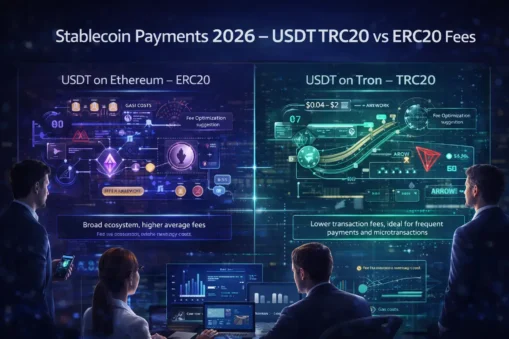
Choosing between TRC20 and ERC20 is a key Stablecoin Payments 2026 decision because it directly impacts USDT transaction fees and margins.Managing Treasury with USDT
Some companies hold USDT as working capital. Others convert instantly. Treasury teams assess business crypto treasury strategy goals before deciding.
Holding digital dollars provides optionality for future vendor payments or trading allocation.
Choosing a Crypto Payment Gateway
A crypto payment gateway sits between blockchain networks and business processes. A crypto payment gateway is like a digital processor that watches wallets, checks transactions, and delivers reports.
When US firms choose the best crypto payment gateway, they look at features, support for compliance, and models that show how much different crypto gateways charge.
Hosted vs Self Custody Setup
Hosted gateways make it easy to create a crypto merchant account. Many of them also come with a USDT checkout plugin for online retailers.
Self-custody crypto payments, on the other hand, require direct wallet management and technological oversight.
Gateway Fees in the USA
Most providers charge a percentage of the total cost plus the cost of the network. Evaluating stablecoin payment processing fees requires reviewing volume tiers and conversion spreads. Companies must calculate total cost including withdrawal fees.
API, Plugins, and Checkout Flow
Strong wallet integration and API documentation matter. Businesses seek a reliable crypto payment API provider that integrates into ERP systems. A smooth checkout process lowers friction and boosts conversion rates.
Comparing Gateway vs Bank Rails
Traditional banks are increasingly looking into stablecoin infrastructure. To compare gateway solutions with banking rails, you need to look at compliance and settlement.
Most gateway models let you pay with stablecoins on many chains, although banks may limit your choice of networks.
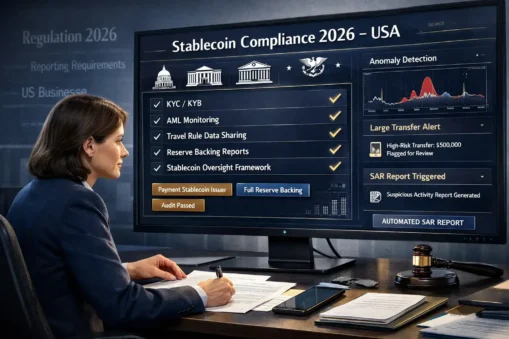
Robust KYC, AML, and Travel Rule processes keep Stablecoin Payments 2026 aligned with evolving US regulations.Compliance and KYC Requirements
Most of the time, gateways take care of KYC onboarding and monitoring. This is in line with what the USA expects from stablecoin regulation in 2026. Regardless of the source, businesses must keep records of all transactions.
Settlement Speed Differences
Blockchain settlement can occur within minutes. Bank integrated rails may add operational processing layers. Speed differences impact liquidity planning.
Operational Complexity Factors
Self-managed systems need to have security for their portfolios. Hosted gateways make things less complicated, but they cost more to keep up. The ideal model for you relies on how big you are and how much risk you are willing to take.
Stablecoin Trading for Businesses 2026
In 2026, trading stablecoins will provide treasuries more ways to grow than just payments. Companies who have too much USDT might look into steady trading tactics. But you need to be disciplined to trade. These are not just random guesses.
Using USDT as Base Pair Asset
Many exchanges offer a comprehensive list of USDT trading pairs. Companies can practice using USDT as a base currency to diversify risk. Liquidity across all platforms facilitates efficient spot trading. Treasury growth through trade
Treasury Growth Through Trading
Some companies allocate a small portion of their assets to stablecoin arbitrage strategies or participation in stablecoin liquidity pools. This activity requires risk management and monitoring.
Risk Controls and Hedging Basics
Treasury teams must define treasury allocation percentages and apply volatility hedge rules. Working with the best exchange for USDT trading or a low fee USDT trading platform improves efficiency while maintaining access to strong order book liquidity.
Reasons Businesses Hold USDT
Having USDT can make it easier to pay vendors and do business in other nations. It also helps you move money around without needing to switch banks straight immediately.
Cross Border Client Payments
USDT cross-border payments speed up correspondent banking for exporters. This makes it easier to send bills and be paid.
Dollar Access Without Banks
Digital dollars give people in places where the value of money is unstable other methods to pay for things. When markets are unstable, this makes them more stable.
Liquidity on Binance and Coinbase
It is easy to switch currencies on Binance and Coinbase because they have deep liquidity. The market is confident because there are a lot of stablecoins.
USA Regulations Impacting 2026
The US government is continuously modifying how it keeps an eye on things. Policymakers look at the standards for reserves that are open and honest. Businesses have to meet the regulations for reporting and the standards for stopping money laundering (AML).
For a deeper view of how full‑reserve rules and oversight are evolving globally, see this overview of global stablecoin regulations 2026 for enterprises.
Stablecoin Oversight Framework
New guidelines are mostly about protecting consumers and checking reserves. This makes people more sure that merchants will use stablecoins on a significant scale.
Travel Rule and Reporting Rules
The Travel Rule specifies that some transaction information must be disclosed between institutions. Gateways can help make it easier to follow the rules.
Reserve Backing Expectations
Issuers must be explicit about their backing. This changes how businesses think about risk. Trust in support leads to widespread use.
Multi Chain Stablecoin Strategy
Choosing the correct blockchain is critical for both cost and dependability. Companies are looking for multi-chain stablecoin payments to decrease their risk.
Ethereum Network Considerations
Ethereum is made up of many elements, which makes it straightforward for developers to use. When there is a lot of traffic, the fees may be higher.
Tron Cost Advantages
Tron normally costs less to transmit USDT. This can help you save a lot of money on charges.
Cross Chain Liquidity Planning
Treasury teams keep an eye on liquidity across chains to make sure they can adapt. Cross-chain bridges need to be thought about very carefully.
Accounting for Stablecoin Payments
How accounting works depends on where you live and what you need it for. According to advice, US companies see stablecoins as either digital assets or cash equivalents.
Recording USDT on Balance Sheet
Businesses need to keep track of how much their acquisitions are worth and any changes that happen. Correct entries in the ledger stop audits from going wrong.
Tax Implications in the USA
Conversion to USD may trigger taxable events. Consulting a tax advisor remains essential.
FX Gain and Loss Treatment
Even dollar pegged tokens may experience minor fluctuations. Finance teams track realized and unrealized gains.
Risks in Stablecoin Payments 2026
Every financial tool carries risk. Understanding risk improves decision making.
Depeg Risk Assessment
Stablecoins may temporarily deviate from one dollar. Diversification reduces exposure.
Counterparty and Custody Risk
Choosing reputable providers lowers counterparty risk. Internal controls protect private keys.
Regulatory Uncertainty Risk
Regulation may shift. Staying informed protects long term operations.
Step by Step USDT Setup Plan
Businesses should define objectives first. Clarity simplifies implementation.
Selecting the Right Gateway
Compare cost, compliance support, and API reliability. Evaluate the best stablecoin payment provider carefully.
Wallet Security Best Practices
Use multi signature setups and restricted access policies. Regular audits protect assets.
Client Communication Template
Provide simple instructions explaining network choice and address. Clear communication reduces payment errors.
Stablecoin Trading vs Holding
Deciding between holding and trading requires policy. Not every company should trade.
When to Convert to USD
Convert when volatility risk outweighs benefit. Liquidity planning drives timing.
When to Trade on Exchanges
Trade only defined allocation percentages. Maintain conservative exposure.
Liquidity Management Rules
Set thresholds for conversion and rebalancing. Document procedures.
Merchant Use Cases in the USA
Stablecoins serve ecommerce, SaaS, and consulting firms. Practical implementation drives adoption. You can also review stablecoin use cases for businesses in 2026 to see how other companies structure wallets, conversion, and off‑ramping.
E Commerce USDT Checkout
Integrating a USDT gateway for ecommerce enables global acceptance. Plugins simplify deployment.
B2B Invoice Settlement
Professional services firms use USDT for international clients. Settlement accelerates revenue recognition.
SaaS Subscription Payments
Recurring billing systems integrate stablecoin APIs. This expands global customer reach.
Reasons Stablecoins Beat Cards
Stablecoins offer predictable pricing and faster finality.
They also support global access.
Cost Comparison with Visa
Card fees accumulate quickly. Blockchain costs remain transparent.
International Payment Advantage
No correspondent banks required. Funds move wallet to wallet.
Settlement Finality Benefits
Confirmed transactions cannot reverse. Merchants gain certainty.
Future Outlook Stablecoin 2030
Adoption continues to expand. Institutional participation grows steadily.
Institutional Adoption Trends
Large firms explore digital settlement rails. Banks integrate tokenized infrastructure.
Growth of USDT Supply
Expanding supply indicates rising demand. Liquidity deepens accordingly.
Treasury Strategy Evolution
Digital assets become part of broader financial planning. Hybrid models combine fiat and stablecoin rails.
FAQs:
Is USDT Legal in the USA
Yes, USDT is legal to utilize in the US as long as firms follow all federal and state laws. Companies must fulfill KYC and AML rules and disclose taxable occurrences in the right way. Always talk to a lawyer before undertaking something big.
Are Stablecoin Payments Safe
Stablecoin payments are usually safe if you choose a reliable supplier and follow appropriate custody rules. There are hazards, such as the possibility of depeg events and platform failure. Internal controls and diversification make it much less probable that something will go wrong.
How Much Are Gateway Fees
Gateway fees are usually between 0% and 1% of the cost of the network. The overall cost changes based on the number of transactions and how they are converted. Make sure to properly compare suppliers before choosing one.
Can SMBs Use Stablecoin Trading
Small businesses can trade stablecoins as long as they have the necessary risk management systems in place. Set aside a little bit of money and make sure the treasury follows the rules. Don’t act on guesses.
What Chains Are Cheapest
Tron often provides lower transaction fees for USDT transfers compared to Ethereum. Network congestion can affect cost. Evaluate based on average transaction size.
How To Stay Compliant
Maintain clear records, use compliant gateways, and monitor regulatory updates. Implement KYC procedures and consult professionals when needed.If you are serious about implementing stablecoin payments 2026 the right way, do not rely on guesswork. Visit https://primepulselogic.com/ to speak with experts who understand USDT business payments, gateway integration, compliance strategy, and treasury optimization. Complete the contact form and start building a payment system that actually works for your business.