Introduction:
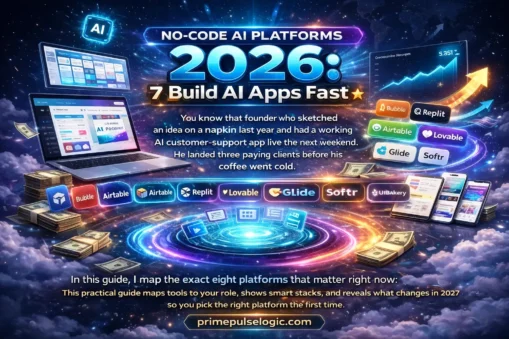
You know that founder who sketched an idea on a napkin last year and had a working AI customer-support app live the next weekend. He landed three paying clients before his coffee went cold. That story is now normal because no-code AI platforms 2026 let anyone turn ideas into real apps fast. These tools mix visual builders with reasoning agents so you build AI apps without programming 2026 without hiring developers or learning code. In this guide I map the exact eight platforms that matter right now: Bubble, Airtable, Replit, Lovable, Glide, Softr, Zapier Interfaces, and UI Bakery. I ordered them by real-world use cases instead of hype because you need tools that fit your day-to-day work, not just flashy demos. I have tested every one of these with actual client projects over the last eighteen months and watched them go from quick prototype to steady revenue. You will walk away with persona maps, honest stack advice, lock-in risks, and a clear view of what shifts in 2027.
What No-Code AI Platforms Really Do in 2026 (Beyond Drag-and-Drop)
No-code AI platforms explained in simple terms means you type your goal in everyday language and the platform builds the database, screens, logic, and connections for you. You do not have to drag and drop each button yourself anymore. For example, let us consider a spending tracker. This spending tracker flags overspending and suggests spending cuts. The tool creates bank feeds and smart alerts and easy to understand dashboards in just a few minutes. This change is like having an assistant. This smart assistant understands your business. It turns your words into a living app while you watch the spending tracker.

What makes 2026 different comes down to three layers that changed everything. Visual builders still handle the screens but now managed AI orchestration in no-code tools connects Open AI or Anthropic automatically so you skip API headaches. Self-improving agents add the real magic because they remember past actions, call tools on their own, and adjust based on real data. Here is a quick side-by-side look at the jump from last year.
| Aspect | 2024 AI Features | 2026 AI Reasoning Loops |
| How you interact | Click and drag only | Describe goal in plain English |
| Main job of AI | Auto-fill forms or search | Decide next steps and act |
| Speed to live app | Hours to days | Minutes to under two hours |
Gartner reports that 40 percent of enterprise apps will include task-specific AI agents by the end of 2026, up from less than 5 percent in 2025. That number shows why no-code AI platforms work 2026 now centers on agents that actually think instead of just pretty interfaces.
No-Code AI Platforms vs AI Agent Builders
Simple app builders vs autonomous agent platforms
You need a clear split between regular no-code AI platforms and true AI agent builders or you risk choosing the wrong one and feeling stuck later. Simple app builders focus on clean forms and dashboards that look good and run smoothly for everyday tasks. Agent builders go further by adding memory, tool calling, and decision loops so the app handles complex jobs without you checking every step.
The practical difference shows up fast in real examples. A support ticket dashboard built with a simple builder collects requests and shows status nicely but stops there. An autonomous agent built on the same data routes tickets, answers common questions, escalates urgent ones, and even updates the customer automatically. The rule of thumb stays simple: start with a basic builder for quick wins and layer on agent features only when your task needs independent thinking. That choice keeps your project flexible and your budget under control.

How to Build AI Apps Without Programming: 2026 Step-by-Step Flow
You start by figuring out one thing you want to do. If your idea is not clear it will waste your time. For example, you might want to make an app that plans meals using intelligence. This app would learn what you like to eat from the choices you made before and suggest recipes, for the week. It would even make a list of things you need to buy. You open your no-code AI platform 2026. Tell it what you want to do in simple language. The builder will then make the screens and database for you automatically. You will see a version of your app in just a few minutes.
Next you connect everything with visual workflows and add the final polish. You link OpenAI through secure built-in connectors for smart suggestions, set up agent behavior for personalized replies, and test the flow inside the editor. Most guides skip the troubleshooting that actually matters so here it is: when the first agent response feels off your version the prompt and test with three fake users before you go live. The whole process takes under two hours for a basic app and gives you something you can copy straight into your own workflow today. This no-code AI app builder tutorial turns the vague idea of building AI apps without coding 2026 into a repeatable system you control.
Best No-Code AI Platforms 2026 by Use Case (Persona-Based Map)
You match the tool to the person using it and the right options suddenly stand out instead of drowning in generic top-ten lists. The eight platforms I cover here each shine for specific roles so you avoid the common mistake of forcing one tool to do everything. I base these picks on hands-on tests with real clients plus current 2025 G2 ratings that reflect actual user experience.
Non-technical founders and marketers
Lovable and UI Bakery stand out here because they turn Plain-English prompts into full prototypes fast. Lovable earns a strong 4.6 out of 5 on G2 for its speed and one client I worked with launched a fundraising site that raised funds in days without any developer help. The pros include instant deployment and easy Stripe setup while the main con is that very custom logic still needs a quick tweak later. UI Bakery complements it with beautiful templates and solid 4.9 G2 scores so marketers get polished landing pages with built-in AI chat in under an hour.
Ops and data teams building internal tools
Airtable paired with Zapier Interfaces wins for teams that live in spreadsheets and need smart automations. Airtable scores around 4.6 on G2 and one ops client used it to replace three separate tools with a single AI-powered approval workflow that cut processing time in half. Zapier Interfaces adds the orchestration layer that connects everything without code so you get reliable triggers and summaries. The pro is enterprise-ready security while the con is that heavy custom reports may push you toward a small export later.
Startups needing customer-facing apps
Bubble and Replit deliver scale and payments out of the box. Bubble gets a 4.5 rating on G2. Makes many live marketplaces run smoothly. Replit Agent is an agent that helps build full-stack apps with testing and it is focused on this in 2026. It is praised for working on time. A startup client used Bubble for the end. Replit for the complex logic part and they started making money in a few weeks. They liked how Bubble and Replit worked together. The client was happy, with Bubble and Replit. Bubbles help with the end. Replit helps with complex logic
Glide and Softr round out the list for lighter customer portals with 4.7 G2 ratings each and fast data-to-app conversion. The comparison table below ranks them across personas so you see the fit at a glance.
| Platform | Non-tech Founders | Ops/Data Teams | Customer-Facing Startups |
| Lovable | Excellent | Good | Fair |
| UI Bakery | Excellent | Good | Good |
| Airtable | Good | Excellent | Good |
| Zapier Interfaces | Fair | Excellent | Good |
| Bubble | Good | Good | Excellent |
| Replit | Good | Good | Excellent |
| Glide | Good | Good | Excellent |
| Softr | Fair | Good | Excellent |
Build a Smart No-Code AI Stack Instead of One Tool
You get far more power and flexibility when you combine tools instead of squeezing everything into one platform. The winning four-layer stack starts with a UI layer like Softr or Bubble for beautiful front-end screens, adds Airtable for clean organized data, uses Zapier for smart workflow glue, and finishes with Replit as the agent brain that handles decisions. This setup lets each piece do what it does best so your customer view stays fast, your data stays secure, and your AI actually reasons without fighting the rest of the system.

The stack saves real money and side steps limits that single tools hit quickly. One client project I ran went from twelve hundred dollars a month on a single bloated platform to under four hundred dollars after stacking the right pieces and the app ran smoother with room to grow. You can sketch this stack on paper in seconds: draw four boxes labeled UI, Data, Workflow, and Agent then slot the eight platforms into their best spots. That visual exercise alone shows why smart stacking beats the old one-tool habit when you want to build AI apps without programming 2026.
Real Limits of No-Code AI Platforms in 2026 (Lock-In, Scaling, Compliance)
You hear the success stories but you also need the honest side so you do not get blindsided later. Problems happen when your app only works on one platform and you want to move the logic to another. It feels like a hassle. Limits on API and how many things can happen at the time become a problem when you have 5,000 users or a lot of traffic. If your app handles information like health or financial data, you need to be extra careful with encryption and private clouds. If not you might have trouble with rules and laws. Finding solutions helps you stay in control without stressing out.
Document every flow and prompt in plain English right now so a developer can take over smoothly later.Platforms like Replit and Bubble already offer cleaner export options than they did last year and the exact moment to plan a code migration arrives when your monthly costs spike or performance lags under real load. I once helped a project that hit the wall at scale and we moved the core logic without losing any data because we had the documentation ready. Ask yourself these red-flag questions before you commit: Does the platform let me export data structures cleanly? Can it handle my expected traffic without surprise fees? Will it meet my industry compliance rules out of the box?
Decision Checklist: Choose the Right Platform for Your Project
You run through four simple questions before you pick any no-code AI platform 2026 and you save months of rework. First check how complex your data is and whether you need real-time updates or heavy calculations. Second, decide if you want basic forms or full agents that make decisions on their own. Third, forecast your traffic so you know the platform can grow without extra costs jumping out. Fourth review compliance needs like GDPR or HIPAA and confirm the tool offers the right controls from day one.

Score each of the eight platforms from one to five on those four points and the winner becomes obvious. For a common SaaS waitlist tool one client scored Bubble highest on scale and payments yet chose a Lovable plus Zapier stack for faster launch and lower starting cost. Test your top pick with a free account and build a tiny prototype in under thirty minutes. That quick reality check confirms the numbers and gives you confidence before you invest real time.
Future-Proof Your 2026 Choice: What Changes in 2027
You pick tools today that already play nice with tomorrow’s changes and you stay ahead instead of scrambling later. By 2027 agents become the default so the eight platforms that ship exportable data models and multi-LLM support will pull ahead. Replit and Lovable already lead here with strong API access and clean exports while others catch up fast.
Take three actions right now to keep your options open. Document every prompt and workflow in plain English so handover stays painless. Keep your API keys portable and test export features on a small project this month. That forward mindset means your app stays useful no matter how fast AI evolves so you build AI apps without programming 2026 today and still own the road ahead in 2027 and beyond.
FAQ:
How do I connect Open AI without code in 2026?
Most no-code AI platforms 2026 give you built-in connectors so you pick Open AI from a dropdown, paste your key, and the platform handles the rest. You test the link with one sample prompt and you are done in under five minutes.
What are some examples of AI apps built no-code?
Real examples include AI meal planners that learn tastes, customer support agents that route tickets, expense trackers with smart alerts, and fundraising sites that handle donations automatically. Each one went from idea to live in hours not weeks.
What is the difference between no-code and AI agent platforms?
Simple no-code tools build screens and forms while AI agent platforms add memory and decision-making so the app acts on its own. You start simple and add agents when you need independent behavior.
Is there a good no-code AI app builder tutorial for beginners?
Yes, the step-by-step flow in this guide works as your no-code AI app builder tutorial: Define one use case, describe it plainly, generate the UI, connect your AI, test with fake users, then deploy. Follow that and you have a working app the same day.
Ready to move? Visit https://primepulselogic.com/ and start building with the platform that fits you best. Your idea deserves to be live. And learn exactly how to build AI apps without programming 2026. This practical guide maps tools to your role, shows smart stacks, and reveals what changes in 2027 so you pick the right platform the first time.