You’ve probably noticed something strange lately. You search on Google, and instead of clicking ten links, you get one big answer right at the top. That’s not a small tweak. That’s a shift. Here’s the thing: AI search engines 2026 aren’t just improving search; they’re rewriting how people find information. You’re no longer hunting for answers. The answers come to you.
This guide breaks it all down. You’ll see how AI-powered search works, where Perplexity AI vs Google actually differs, and which tools win depending on what you need. By the end, you’ll know exactly which AI search engine is best for you.
AI Search Engines 2026: What Changed in Search
From links to AI-powered answer engines
Search used to be simple. You typed keywords, got links, then did the hard work yourself. That model now feels outdated. The shift from links to answers defines the evolution of search engines in 2026. Today’s systems act more like an answer engine vs. a search engine. Instead of listing pages, they synthesize information. This is powered by generative AI search and machine learning search engines that interpret meaning, not just keywords.
For example, ask a complex question like “best laptop for video editing under budget,” and instead of ten links, you get a structured answer. That’s conversational search in action.
Why users prefer AI search alternatives now
People are switching fast, and it’s not random. The appeal comes down to speed and simplicity. Users want answers, not homework.
With AI-powered search alternatives, you skip the tab-hopping. The system reads multiple sources and gives you a clean summary. That’s why tools built on semantic search technology feel more intuitive.
Another reason is adaptability. You can refine your query naturally. Instead of typing again, you just ask follow-ups using natural language queries.
Reasons related to the article: shift in user intent
User behavior has flipped. People no longer search in fragments. They ask full questions. That’s real-time search intent understanding. At the same time, zero-click search results are rising. Users often don’t visit websites at all. They get what they need instantly. What this really means is simple. If your content isn’t structured for AI answers, it won’t be seen.
What Is AI-Powered Search and How It Works
AI models behind modern search engines
Modern systems rely on large language models combined with real-time data retrieval. This mix powers AI search results accuracy and makes responses feel human.
Unlike engines that use static indexing, AI search engines 2026 use dynamic processing. They pull information, analyze it, and generate responses then and there. This mix of approaches is why AI search, for research, has gotten really good.
Difference between AI search and chatbots
At a glance, AI search engines and chatbots might look similar. There’s a big difference. Chatbots make answers from scratch. AI search engines, on the other hand, find information, check it, and then generate responses.
That’s why AI search vs traditional search matters. One relies on stored knowledge, the other actively pulls fresh data.
This distinction is critical when accuracy matters, especially for AI search for academic papers or technical queries.
Reasons related to the article: smarter queries
Search is no longer about keywords. It’s about context. Users now expect systems to understand intent, tone, and nuance.
That’s why AI search user behavior is shifting toward conversation. You ask, refine, and explore, all in one flow. This creates a smarter, more fluid search experience.
Perplexity AI vs Google, Head-to-Head Comparison
Speed vs depth, which saves more time
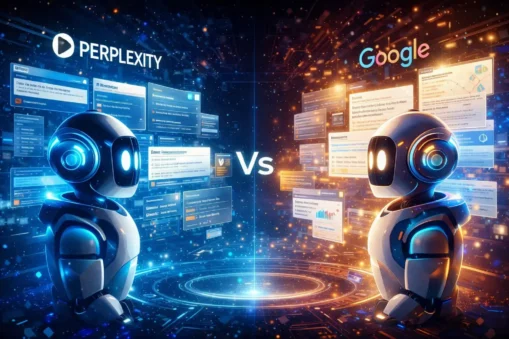
Google still wins raw speed. It feels instant. But speed alone doesn’t tell the full story. Perplexity focuses on depth. It may take a second longer, but it delivers a complete answer. That’s where time savings happen. In a real AI search comparison, total effort matters more than milliseconds.
Citations and trust, who shows sources
This is where things get interesting. AI search with citations is Perplexity’s biggest strength. Every claim links to a source.
Google, on the other hand, relies more on authority signals. It shows links, but not always inline references. That difference changes how users perceive trust.
Reasons related to the article: accuracy debate
Accuracy isn’t just about being right. It’s about transparency. Users want to see where information comes from.
Here’s a quick table to clarify:
| Feature | Perplexity AI | |
| Speed | Moderate | Very fast |
| Depth | High | Medium |
| Citations | Strong | Limited |
| Local search | Weak | Strong |
This is why many ask, is Perplexity better than Google? The answer depends on what you value.
Where Perplexity AI Wins in 2026

Best for research and deep analysis
Perplexity shines in structured thinking. It’s ideal for AI search for developers, students, and analysts who need layered answers.
Instead of scattered links, you get a synthesized explanation. That’s why it dominates in AI search for content creation.
Strong citation-based answers explained
Each response includes references. That builds trust and reduces guesswork. For tasks like AI search for SEO research, this feature becomes invaluable. You can verify claims instantly.
Reasons related to the article: research advantage
The biggest advantage is time. You skip manual filtering and get curated insights. For heavy users, this translates into hours saved each week.
Where Google Still Dominates Search in 2026
Local search, maps, and real-time data
Google owns local intent. Whether you’re searching for restaurants or directions, it delivers unmatched accuracy. This is where the advantage of the fastest AI search engine matters most.
Shopping, ads, and ecosystem advantage
Google’s ecosystem is massive. From YouTube to Shopping, everything connects. For transactional queries, it remains the default choice.
Reasons related to the article: mass adoption
Habit is really important. A lot of people trust Google. It is hard to switch to something so most people just stick with what they are used to.
Top AI-Powered Search Alternatives in 2026
Bing Copilot, Brave, ChatGPT search
Some tools are changing the way we search for things on the internet. Bing is a tool that uses intelligence and traditional search methods together. Google and ChatGPT are different. ChatGPT is like having a conversation. Each of these tools is good for different things; some are fast, and some give you more information.
Privacy-focused AI search engines
People are starting to care about their privacy. Some tools, like Brave, are trying to help with this; they are search engines that focus on privacy. People who want to keep their information private are moving away from tools that collect a lot of data about them.
Reasons related to the article, alternative options
There’s no single winner. The rise of alternatives to Google search AI shows users want flexibility. Different tools solve different problems.
Best AI Search Engine by Use Case
Research, coding, shopping, and local queries
Each tool excels in a specific area. Perplexity dominates research. Google wins local. ChatGPT handles coding. That’s why a smart strategy involves switching tools.
Which tool fits students and marketers
Students benefit from structured answers. Marketers rely on insights from AI search tools comparison platforms. Developers prefer tools that handle technical depth.
Reasons related to the article, task-based choice
There’s no universal solution. The best approach is task-based selection.
Hidden Limitations of AI Search Engines 2026
Hallucinations and outdated information
AI can still make mistakes. Sometimes it fabricates details. Other times, it relies on outdated data. That’s why validation remains important.
Bias, censorship, and data gaps
Every system is like a mirror of the information it was trained on. This means it can have biases or not show all the possibilities. People who use these systems should always be on the lookout for these missing pieces.
Reasons related to the article, risk awareness
Artificial intelligence is really powerful. It is not perfect. If you trust it completely without checking, you can make mistakes. Smart people always double-check the information they get.
Future of AI-Powered Search and SEO Strategy

AI overviews and zero-click searches
Google is now giving answers away, so people do not have to click as much. This is changing how many people visit websites and how visible they are. The content on these websites needs to change with this.
How to rank in AI search engines
To rank in AI search engines in 2026, content must be clear, structured, and authoritative. Focus on answering questions directly. Use strong headings and credible sources. For deeper insights, check https://developers.google.com/search for official guidelines.
To be ranked high on AI search engines 2026, the content needs to be easy to understand, well-organized, and trustworthy. You should focus on answering questions. Use headings and sources that people respect. If you want to know more, you can check https://developers.google.com/ and search for the rules.
Reasons related to the article, SEO evolution
SEO is changing. It’s no longer about keywords alone. It’s about clarity, structure, and trust.
FAQs:
Which AI search engine is best?
The best AI search engine for you depends on what you need. Perplexity is great for research. Getting detailed answers. Google is really good at giving you results, helping you find things near you, and keeping you up to date. Most people find it helpful to use both Perplexity and Google, depending on what they’re trying to do.
Is Perplexity better than Google?
Perplexity is the way to go if you need to do research and get answers based on facts. Google is better for finding things near you, shopping, and getting answers. It really comes down to whether you need to dig or just get a fast answer.
How do AI search engines work?
AI search engines use language models and get information in real time. They look at what you’re asking, gather information, and give you answers using semantic search technology that understands what you mean.
Are AI search engines accurate?
They are usually right. Not always. How accurate they are depends on where they get their information and how complicated your question’s. Tools that use AI search with citations and give you sources to back up their answers tend to be more trustworthy.
What are the alternatives to Google search AI?
There are options like Perplexity, Bing Copilot, ChatGPT search, and Brave. Each one has its strengths, like keeping your information private, having conversations, or giving you research-based answers.
Final Thoughts:
The way we search for things is changing fast. What worked a year ago does not work today. The fact that AI search engines are getting popular in 2026 shows that people want smarter answers.If you need help from an expert, you can visit https://primepulselogic.com/. They are really good at coming up with strategies that use AI to help your content show up near the top in Google, AI tools, and more. Reach out to them today. Stay ahead of the game.