Best Indie Games Success 2026 Moves for a $5K Newsletter
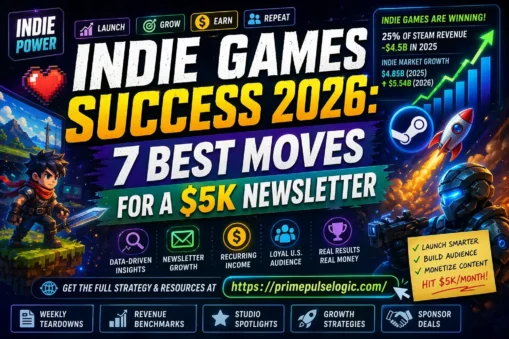
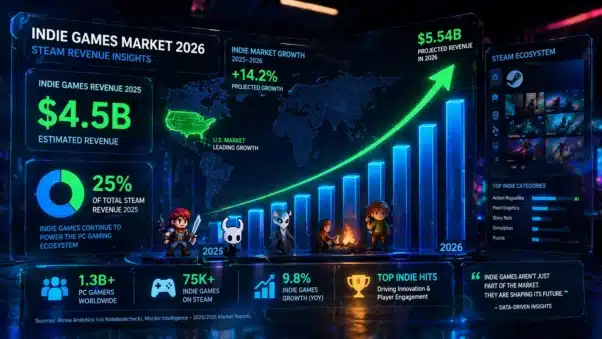
Indie Games Success 2026 is not just about making games; it is about understanding where the money is, where the audience is, and where the next opportunity sits. Indie games took about 25% of Steam’s 2025 revenue, which came out to roughly $4.5B, while the indie game market is projected to grow from $4.85B in 2025 to $5.54B in 2026. At the same time, Google’s AI Overviews now show snapshot answers with links, which means clear, question-based content has more value than fluffy writing that goes nowhere. That is why this topic works so well for a U.S. newsletter focused on Steam, market forecasts, recurring revenue, and commercial intent.
The real angle here is simple. You are not just writing about indie game revenue in 2026. You are showing U.S. indie studios, U.S. game developers, and even the wider U.S. creator economy how game data can become a content business. That is the bridge most articles miss. They talk about games. You are talking about games, money, audience growth, and newsletter revenue in one clean model.
Why Indie Games Success 2026 Matters in the U.S.
Steam revenue, market size, and the real opportunity
The U.S. indie game market matters because it sits at the center of PC gaming, creator-led marketing, and subscription-first media. Steam still serves as the main proving ground for digital storefronts, so when indie titles capture a large share of revenue there, it is a signal worth paying attention to. Alinea Analytics, as reported by Notebookcheck, says indie games generated about 25% of Steam revenue in 2025, which works out to roughly $4.5B. Mordor Intelligence also projects continued growth in the broader indie market through 2026 and beyond.
What this really means is that indie game growth strategy is no longer a side note. It is a real business category. U.S. readers care because they want to know where the opportunity lives, how small game studios stay alive, and why some teams win while others vanish after launch. That is exactly the kind of answer people search for in Google, AI summaries, and voice queries. If your article gives that answer fast, it earns attention.
What Indie Game Revenue Looks Like in 2026
Premium sales, DLC, subscriptions, and long-tail cash
Indie game revenue 2026 is not one clean stream. It is a stack. The first layer is premium sales, where a game earns upfront from buyers. The second layer is DLC revenue, expansions, and sometimes a season pass. The third is the long tail, where older games keep selling through discounts, updates, bundles, and community momentum. That long tail matters because player retention and repeat visibility can keep cash flowing long after launch.
| Revenue Layer | What It Means | Why It Matters |
| Premium sales | One-time purchase at launch | Strong first signal, easier to explain |
| DLC revenue | Add-on content after launch | Extends the life of the game |
| Subscription model | Ongoing income through access or bonuses | Smooths monthly cash flow |
| Long-tail cash | Sales that continue over time | Keeps older titles alive |
| Publishing deals | External funding or distribution support | Helps smaller teams scale faster |
A smart indie game business model in 2026 uses more than one path. Some studios lean on early access to test demand. Others use revenue share with publishers. A few build around community support, UGC, or mobile spin-offs. The point is not that one model wins every time. The point is that a studio with a good product and a decent launch plan can still make serious money if it understands the market and ships with discipline.
Why Small Game Studios Still Win in 2026
Speed, niche focus, and creative independence
Small game studios still win because they can move faster than larger teams. They can test an idea, read community feedback, and adjust without waiting for six approval chains and a committee meeting that somehow needs a meeting about the meeting. That speed matters in a market where taste changes quickly, and a game can rise or die based on a few visible signals like wishlist growth, stream clips, and early reviews.
Creative independence matters too. Smaller teams can target a niche with more precision, whether that means a horror puzzle game on PC gaming, a cozy farming sim, or a roguelike built in Unity, Unreal Engine, or Godot. They do not need to please everyone. They need to delight the right people. That is why the best indie teams often look less like giant studios and more like focused craft shops with a sharp point of view.
This is also where your newsletter angle gets stronger. Readers do not just want to know who won. They want to know why the game worked, what the team did differently, and how that insight applies to the next launch. That is useful. That is repeatable. That is sellable.
Which Game Development Trends 2026 Matter Most
AI tools, cloud distribution, and cross-platform builds
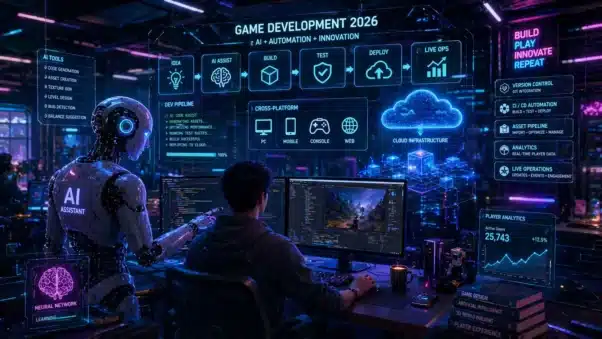
The biggest game development trends for 2026 are the ones that help small teams do more with less. AI-assisted development is one of them. It can help with concept work, copy drafts, prototyping, testing, and even QA automation when used carefully. The smart version is not blind automation. It is speed with guardrails. Used well, AI can reduce waste and help a tiny studio act bigger than it is.
Another major shift is cloud publishing and easier cross-platform release planning. A studio that launches on PC, then expands into mobile or console, multiplies its reach. That matters because app-store distribution and storefront diversity give indie teams more ways to find buyers. Some teams will still focus on mobile indie games, while others will stay laser-focused on PC. Either way, the winners are thinking across platforms, not just across genres.
A third trend is speed in audience-building. Discord marketing, Reddit promotion, YouTube devlogs, and TikTok game marketing now work together like a stitched-up ladder. One post does not do the job. A pattern does. That pattern builds trust, drives audience segmentation, and improves the odds of a stronger launch. The same logic applies to newsletters. The more useful your posts are, the more likely readers are to stay. That is just basic human behavior, which is inconvenient for anyone hoping to skip work.
Why a Newsletter Is the Smart Business Layer
Turn market data into recurring reader value
A newsletter works because it turns information into recurring revenue. Substack makes this model easy to understand, since it is a media platform where creators earn from subscriptions, and its paid guides focus on setting goals, growing a free list, and building a paid readership. That makes it a strong fit for an indie game newsletter that wants to monetize market knowledge instead of chasing random traffic.
The best part is that your newsletter does not need to act like a news dump. It can act like an interpreter. You can take a launch report, a revenue benchmark, a publishing shift, or a market forecast, then turn it into something a busy reader can use in two minutes. That is the real product. Clarity. Not noise.
Here’s the simple logic. Games create the raw material. Your writing creates the meaning. That meaning becomes trust. Trust becomes a paid subscriber. Paid subscribers become newsletter revenue. That is the ladder. And yes, humans love a ladder as long as someone else installs it.
How to Build a $5K Monthly Newsletter Model?
Free growth, paid tier, sponsors, and products
A build $5K monthly newsletter plan should use more than one income stream. Free growth brings in readers. A paid tier converts your best readers. Sponsor placements bring in brand revenue. A digital product or consulting offer adds another layer. That mix matters because one weak stream will not carry the whole business.
| Income Stream | Example | Role in the Model |
| Free list | Email signups from social and search | Top of funnel |
| Paid tier | Deep-dive reports and analysis | Core recurring income |
| Sponsors | Game tools, engines, analytics, services | Monthly boost |
| Digital product | Templates, checklists, teardown packs | Extra revenue |
| Consulting offer | Strategy calls or launch reviews | High-value add-on |
The smartest way to position this on Substack or your own site is to build around one audience and one promise. For example, you could serve a U.S. newsletter audience readers who want indie publishing strategy, launch teardowns, and market analysis. That is clearer than saying you cover “gaming and business.” That kind of broadness sounds flexible, but it usually just means confused.
A practical growth plan looks like this. Use lead magnet content to collect subscribers. Publish one strong free issue each week. Reserve deeper analysis for paying readers. Then, build a simple media kit once you have enough open rate and engagement to justify sponsor outreach. That is how you move from a content hobby to a real monthly income.
What to Publish for U.S. Readers Every Week?
Launch teardowns, revenue benchmarks, studio spotlights
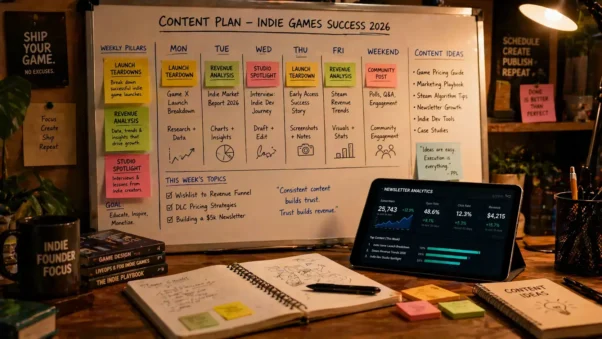
Your weekly content should feel useful before it feels clever. The best format is simple, clear, and repeatable. One week, you publish a launch teardown. Next week, you will analyze a game revenue benchmark. Then you feature a studio spotlight. That rhythm helps readers know what to expect, and it gives your brand a predictable shape.
For the American game market, this kind of reporting works because it is practical. A developer wants to know what happened on launch day. A publisher wants to know what kind of team managed the result. A creator wants to know what angle will get clicks. A founder wants to know whether the idea can become money. That mix of motives is exactly why your content has commercial intent.
A strong issue can also include comparisons between Steam indie revenue stories and smaller platform wins, especially when the game uses early access, wishlist growth, or strong post-launch updates. You can also translate broader industry trends into plain English, which matters a lot for U.S. game developers who do not have time to read long analyst decks.
What Can Kill the Newsletter, and How to Avoid It
Weak niche, overfree content, and burnout traps
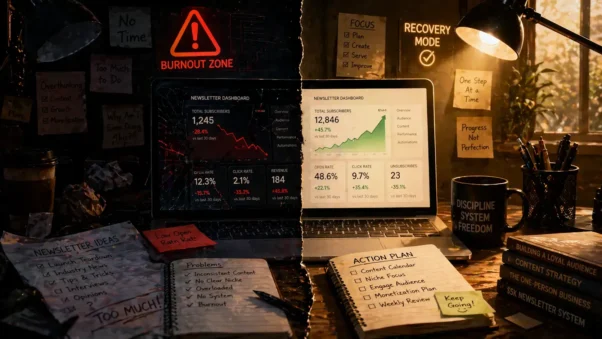
The fastest way to kill an indie game newsletter is to make it too broad. If every issue tries to cover everything, readers stop knowing why they should care. Another mistake is giving away every useful idea for free and leaving no reason to upgrade. Then there is burnout, which hits when the publishing schedule is built on ambition instead of reality.
You also need to respect how AI search works now. Google’s AI Overviews give users quick summaries with links, which means your writing has to answer the question quickly and clearly. Question-style headings, short direct sections, and useful takeaways improve your odds of being surfaced in search summaries and voice-style queries. That is the practical side of GEO, even if nobody on earth enjoys the acronym parade.
The fix is not complicated. Keep one sharp niche. Keep one clear publishing promise. Keep one strong conversion path. That is how you protect recurring income and avoid turning your newsletter into a crowded drawer full of half-finished ideas.
FAQs:
What does Indie Games Success 2026 mean?
It means indie games are no longer just creative projects; they are a serious business category. In 2026, the opportunity lies in Steam, market growth, and smarter monetization. That is why readers care about both game outcomes and newsletter strategy.
Can a newsletter really make $5K a month?
Yes, but not from one magic source. A subscription model, sponsors, digital products, and consulting can combine to reach that level. Substack’s own paid guides show that growth works best when you set goals, grow a free list, and build paid readership carefully.
Why use Substack for an indie game newsletter?
Substack is useful because it lets creators publish, collect subscribers, and offer paid access in one place. It also fits a content business built on recurring reader value. That makes it a clean choice for a focused indie game business model.
What should I publish each week?
Publish one launch teardown, one revenue benchmark, and one studio spotlight on a rotation. That keeps the newsletter practical, repeatable, and easy to scan. Readers want information they can use, not a random pile of opinions with a logo on top.
What kills a newsletter fastest?
A weak niche kills it first, followed by overfree content and burnout. If readers cannot tell what you stand for, they will not trust you, and if you never create paid value, they will never convert. Clear positioning fixes most of that.
Final Build the Model Before Everyone Else Copies It
If you want to turn Indie Games Success 2026 into a real content asset, start with a sharp niche, a simple publishing system, and a monetization plan that actually makes sense. PrimePulseLogic can help you shape the SEO strategy, newsletter structure, and content roadmap needed to make that work.
Reach out through https://primepulselogic.com/ and turn the idea into a business before the crowd catches on.