
Introduction:
AI Productivity Tools in 2026 can save real time, but only when you use them to remove repetitive work instead of piling on more apps. That is the simple truth. The best setup combines AI productivity software, workplace automation, and AI workflow tools so your team spends less time on admin and more time on real decisions. In this guide, you will see what these tools actually do, which ones fit daily work, where the hidden costs hide, and how to measure real value without guessing.
Here is the thing: not every tool saves time in the same way. Some tools help AI save time at work by writing, summarizing, and cleaning up rough drafts. Others show what AI can automate by moving data between apps and handling repeat steps for you. The strongest use of the best AI tools for work is not shiny novelty, it is boring consistency, the kind that keeps your week from getting eaten alive by small chores. That is where task automation, business process automation, and smart workflows start paying off.
What Are AI Productivity Tools in 2026?

AI productivity tools are software products that help people finish work faster by handling drafting, search, summaries, scheduling, app handoffs, and repetitive follow-ups. In practice, they sit inside your productivity stack and reduce repetitive task automation pain, which is why they matter so much for teams that live in docs, inboxes, meetings, and project trackers. In 2026, the category is broader than a chatbot. It now includes writing tools, meeting tools, knowledge management systems, and no-code automation platforms that connect your apps and move work along with less friction.
What changed is the shape of the work itself. The best tools no longer just answer questions. They live inside the workflow, which means they can summarize a page, create action items, search your workspace, trigger follow-ups, or turn a meeting into a task. That is why AI assistants and app integrations matter so much now. They do not just make work feel faster; they reduce the number of times you have to switch tabs, copy data, or rewrite the same thing twice.
Can AI Really Save 40 Hours of Work Each Week?
Yes, it can, but not in the magical way people sometimes imagine. AI saves time when your week is full of repeat work, messy notes, routine writing, follow-up emails, and manual routing between tools. A single person will not always save 40 hours every week, but a team that handles extensive workflow automation and app integrations can claw back a significant amount of time over the month. That is why the headline works. It points to the scale of the problem, not a promise that every user gets the same result.
A simple way to think about it is this: AI does not replace judgment; it removes drag. If your team spends 10 minutes after every meeting writing notes, assigning tasks, and drafting the follow-up, that adds up fast. If your support team answers the same questions all day, AI for support teams can trim the first draft time. If your sales team keeps chasing lead status updates, AI for sales follow-up can keep the pipeline moving. The real gain comes from repeated wins, not one dramatic shortcut. That is the difference between a tool that looks clever and a tool that actually changes the week.
“The best automation is the one you barely notice.”
Which AI Tools Are Best for Daily Work?

For daily work, the best tools are the ones that fit the places where work already happens. That usually means notes, docs, email, chat, and calendar. If a tool makes your day more complicated, it is probably not helping. Strong AI tools for small business setup keep the stack lean and use AI tools for remote teams to cut down on status churn, handoff delays, and duplicate work. The goal is not more software. The goal is less friction.
Notion AI for notes, docs, and summaries
Notion AI works best when your team already uses Notion as a workspace. Notion says its AI layer includes AI Meeting Notes, Enterprise Search, knowledge base support, docs, projects, integrations, and custom agents that help automate busywork. It also says AI is included with its Business and Enterprise plans, with limited trial usage on other plans. That makes it a strong fit for note-taking, page summaries, meeting notes, action items, team wiki work, document drafting, project pages, content cleanup, internal documentation, and research synthesis. In plain English, Notion AI is useful when you want your brain dump to turn into something organized without three extra passes.
Microsoft Copilot for Microsoft 365 tasks
Microsoft says Copilot turns data into insights inside the apps people already know, and its service documentation shows agentic capabilities in Word, Excel, and PowerPoint. Microsoft also describes Copilot Pages as an editable, shareable canvas for turning AI responses into working pages. That makes how Microsoft Copilot works easy to explain. It’s inside Microsoft 365 and helps with email drafting, spreadsheet analysis, meeting summaries, business writing, enterprise productivity, document assistance, and broader office automation. If your team already lives in Outlook, Word, Excel, and PowerPoint, Copilot feels less like a new tool and more like a smarter layer on top of the system you already use.
Zapier vs Make.com, Which Automates Better?
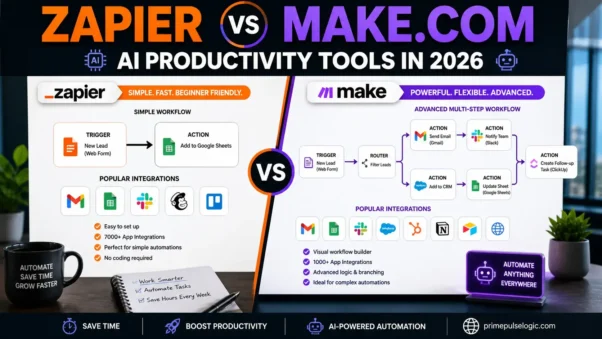
The answer depends on the kind of work you need to move. Zapier is built for fast, beginner-friendly automation. Its pricing page says it connects more than 8,000 apps, uses tasks as the billing unit, and helps users move data between apps without coding. That makes how Zapier works easy to grasp: you set a trigger, choose one or more actions, and let the workflow run. It is a strong match for simple automation, form automation, email automation, lead routing, and teams that want quick wins without a steep learning curve.
Make.com takes a different route. Its product page says it connects 3,000+ pre-built apps and lets people build and manage automations and AI agents visually, in code, or with a prompt. Its pricing and comparison pages also show a credit-based model and highlight the visual builder, modules, branching logic, multi-step automation, and integrations at scale. That makes Make.com a better fit for complex workflows, conditional paths, data mapping, and more advanced process automation. In short, Zapier is usually the cleaner lane for speed, while Make.com is the better playground when the logic gets messy.
| Tool | Best for | Why it ssavetime |
| Notion AI | Notes, docs, summaries, and team knowledge | AI Meeting Notes, Enterprise Search, docs, projects, and agents reduce cleanup work |
| Microsoft Copilot | Microsoft 365 users | Helps in Word, Excel, Outlook, PowerPoint, and Copilot Pages |
| Zapier | Simple task-based automation | 8,000+ apps and no-code triggers and actions |
| Make.com | Complex visual automation | Visual builder, branching logic, and multi-step scenarios |
| ChatGPT | Drafting, brainstorming, and fast answers | Helps turn rough ideas into working text or plans |
| Grammarly | Editing and polishing | AI writing help for drafts, rewrites, and clarity |
| Slack AI | Team communication | Summaries, search, notes, and workflow help inside Slack |
| Loom | Async updates and screen recordings | Cuts live meetings and long explanation threads |
| Otter | Meeting transcription and follow-up | Turns meetings into searchable notes, summaries, and action items |
| Motion | Auto-scheduling and task planning | Automatically schedules tasks and replans the day |
What Are the Hidden Costs of AI Automation?
The highest hidden cost is not money, it is maintenance. A workflow may look cheap on a pricing page, then grow expensive once you factor in setup time, retries, training, and the effort of keeping it alive when apps change. Zapier bills by tasks, while Make.com bills by credits or operations, so the real cost depends on volume and how many steps your workflow runs. That means the tool that looks cheaper at first can become pricier once your automations start firing all day. This is why AI automation examples should always be judged in context, not in a vacuum.
There is also the human cost. Teams often stack tools without removing old habits. Then they wonder why nothing feels simpler. A lean AI automation business model should reduce work, not add clutter. The best teams use AI workflows to speed up approvals, updates, and handoffs, and keep one person responsible for ensuring the system still works. That matters even more for AI tools for small businesses and AI tools for remote teams, because smaller teams feel broken automations faster than large ones do. If you want true operational efficiency, the tool is only half the story. The process around it matters just as much.
Which 10 AI Tools Replace Repetitive Work Best?
Best AI tools for work by use case means matching the tool to the job instead of chasing the loudest brand. If you want AI productivity tools in 2026 that truly earn their place, think in categories. Use Notion AI and Copilot for knowledge work. Use Zapier and Make.com for automation. Use Slack AI, Otter, Loom, Grammarly, ChatGPT, and Motion to remove the little tasks that keep eating your day. That is where repetitive task automation turns into real-time savings.
For AI automation business tools for U.S. teams, the winning pattern is simple. Sales teams can use automation for lead routing and follow-up. Support teams can use it for inbox triage and response drafting. Operations teams can use it for approvals, reporting, and document movement. Product teams can use it for meeting notes, research synthesis, and page summaries. In each case, the point is the same: the tool should remove the dull part so people can do the useful part. That is also why how to automate repetitive tasks is now one of the most valuable questions a business can ask.
Imagine a five-person U.S. marketing team. Before automation, every client call creates the same mess: notes in one place, tasks in another, follow-ups in someone’s head, and action items that slip. After they add Notion AI for notes, Slack AI for summaries, and Zapier for routing, the workflow gets cleaner fast. The result is not just speed. There are fewer dropped balls. That is what AI for sales follow-up, AI for support teams, and AI for operations look like when they are done well. And that is how AI Productivity Tools in 2026 should be judged, by the work they remove, not the hype they create.
How Do You Measure Real Time Saved?
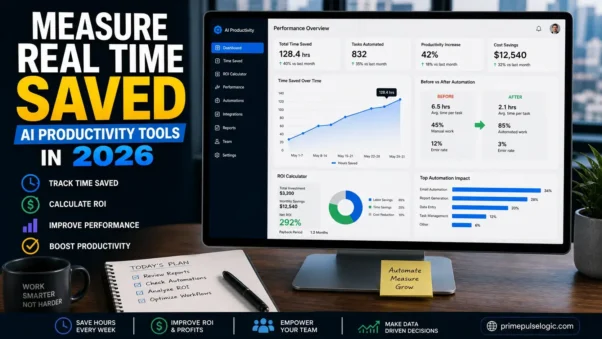
Start with the old way of working. Write down how long the task takes before automation, then compare it with the new way after the tool is in place. Next, subtract setup time and maintenance time. That gives you a much clearer ROI picture than a vague “this feels faster” opinion. A clean formula is simple: manual time minus setup time minus maintenance time equals real time saved. That is how you separate actual gain from shiny-tool excitement.
A smart team also tracks the quality of the output. Faster is great, but if the output is sloppy, you have only moved the bottleneck. The best AI workflow tools improve both speed and quality by reducing rework, not just by making the first draft quicker. That is why a good rollout should always answer three questions: what got faster, what got cleaner, and what still needs a human. When you measure it that way, AI productivity tools in 2026 stop being a buzz phrase and start becoming a real business asset.
FAQs:
What are AI productivity tools in 2026?
They are apps and platforms that help you write, summarize, search, schedule, and automate work faster. The strongest ones now live within your daily workflow rather than outside it.
Can AI really save 40 hours of work each week?
It can, but usually across a team or across many repeat tasks, not from one magic feature. The biggest gains come from task automation, knowledge management, and reducing handoffs.
Is Notion AI better than Microsoft Copilot?
Notion AI is better when your work lives in Notion. Copilot is better when your team lives in Microsoft 365. The right choice depends on where your notes, docs, and decisions already sit.
Is Zapier better than Make.com for beginners?
Usually, yes. Zapier is simpler to learn, while Make.com gives you more control for branching logic and multi-step workflows.
How do you prove ROI from AI automation?
Measure the old manual time, measure the new automated time, then subtract setup and upkeep. If the workflow saves time every week and lowers rework, the ROI is real.
Ready to Turn AI Productivity into Real-Time Savings?
If you want practical help choosing the right AI productivity tools in 2026, building cleaner workflow automation, or mapping a better productivity stack, PrimePulseLogic is the place to start. The right setup can save hours, lower busywork, and make your team feel less boxed in by repeat tasks. Reach out through the contact form on https://primepulselogic.com/ and turn the next workweek into something lighter, sharper, and far less chaotic.
Final note: AI Productivity Tools in 2026 work best when they remove friction, not when they add noise. Pick the right tools, measure the real time saved, and build a system your team can actually keep using.