
Substack Newsletter Income 2026 is not magic, and it is not a lottery ticket either. It is a business model built on paid subscriptions, direct audience trust, and steady subscriber growth. Substack positions itself as a platform where creators can build a paid base and own their direct relationship with readers, while its recommendation network and app now drive a large share of new subscriptions, which means discovery still matters a lot.
What this really means is simple. If you want Substack income in 2026, you need more than good writing. You need real data, real math, and a monetization guide that shows how creator revenue turns into take-home pay after fees, payment processing fees, and churn. Substack says it charges 10% on paid subscriptions, and Stripe adds its own fee. That is the part many creators skip until the money starts leaking out of the bucket.
Reasons This Substack Income Topic Matters in the U.S.
Why newsletter income is a real business model
In the U.S. creator economy, a newsletter is no longer just a side project. It can act like an email-first business, a subscription business, or a full media business if the audience is strong enough. Substack’s positioning centers on helping creators earn from subscriptions, and it frames the product as a way to build a paid subscriber base while maintaining direct relationships with readers. That is why newsletter revenue matters now, not later.
Why U.S. creators care about ownership and fees
The U.S. audience tends to care about scale, margins, and ownership. A newsletter business model only works if the creator can protect audience ownership and control the platform risk that comes from leaning too hard on a single service. Substack says creators own their intellectual property, mailing list, and subscriber payments, which sounds good because it is good. But creators still pay the platform cut, so ownership and profitability are not the same thing.
How Big Substack Is in 2026, and What It Means

Paid subscriptions, reader base, and growth signals
Substack crossed 5 million paid subscriptions by 2025, and Reuters reported that paid subscriptions had passed that mark as the platform continued to grow. The larger point is not just size, it is signal. A platform with that many paid users proves the market for paid newsletter products is real, especially for niche experts, journalists, and creators who can build a clear offer.
Why the built-in network changes discovery?
Substack’s recommendation network and app now drive 50% of all new subscriptions and 25% of new paid subscriptions on the platform. That is huge. It means discovery is not only about social media or search, it is also about being connected to the right publication graph. For a newsletter business, that changes the playbook, because referrals and recommendations can lower acquisition cost faster than paid ads.
Real Income Math: Average, Median, and the $10K Wall
Why averages mislead first-time creators
Here is the ugly truth. The creator economy is very top-heavy. Business Insider reported that the top 10% of creators captured 62% of ad payments in CreatorIQ’s 2025 dataset, while the median creator earned $3,000. The average can look healthy while the median stays low, which is exactly why first-time Substack writers should not confuse headlines with income reality. This is not a Substack-only number, but it is the clearest warning sign for anyone studying Substack earnings and reader revenue.
The churn problem behind small paid lists
Small lists often look fine at first, then churn rate quietly eats the base. Someone subscribes, reads three posts, forgets the value, and leaves. Another credit card fails. Another reader downgrades. That is why paid subscriber income can stall even when top-line subscriber growth looks decent. In practice, conversion rate and retention matter more than vanity subscriber counts.
A simple income benchmark table
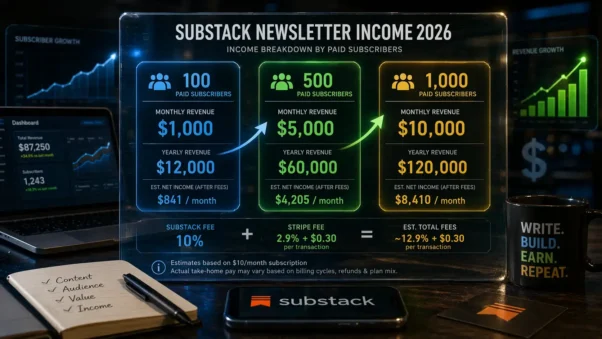
| Paid subscribers | Gross monthly revenue | Gross yearly revenue | Rough net after Substack + Stripe* |
| 100 | $1,000 | $12,000 | about $841/month |
| 500 | $5,000 | $60,000 | about $4,205/month |
| 1,000 | $10,000 | $120,000 | about $8,410/month |
This is an estimate based on Substack’s 10% fee plus Stripe’s 2.9% and 30¢ processing fee on monthly billing. Actual take-home revenue varies by plan mix, refunds, and whether readers pay monthly or annually.
How Many Subscribers You Need to Hit Income Goals
100, 500, and 1,000 paid subscriber scenarios
At $10 a month, 100 paid subscribers gives you $1,000 in monthly recurring revenue and $12,000 in yearly gross revenue. At 500 paid subscribers, you are already in serious creator revenue territory. At 1,000 paid subscribers, you have a real business, not a hobby pretending to be one. This is where subscriber math stops being theoretical and starts becoming a profit estimate you can plan around.
What $10 pricing means after conversion
Pricing only works when the list converts. A newsletter with 1,000 total subscribers and a 2% conversion rate has only 20 paid users. That is why conversion optimization matters as much as writing quality. A small list can still produce monthly income, but only if the offer is sharp and the paid tier feels worth the money. This is the difference between a paid newsletter and a polite email habit.
Substack Fees and Stripe Costs Explained Clearly
How the 10% cut affects take-home pay
Substack says it charges 10% on paid subscriptions, and Stripe adds card and billing fees. That means a creator’s net income is always lower than the gross number shown in the dashboard. At scale, that cut becomes painful. On $5,000 in monthly subscription revenue, the platform cut alone is $500 before Stripe even touches the money. That is why smart creators track take-home pay, not just revenue.
Why annual plans often beat monthly plans
Annual billing usually improves subscriber retention and smooths cash flow. It also lowers the chance that a reader disappears after one or two months. Substack lets creators set monthly and annual plans, and the platform says it does not charge readers extra fees beyond the creator’s plan pricing. For a premium newsletter, that means annual plans can support a stronger recurring income stream.
Substack vs Ghost fee comparison
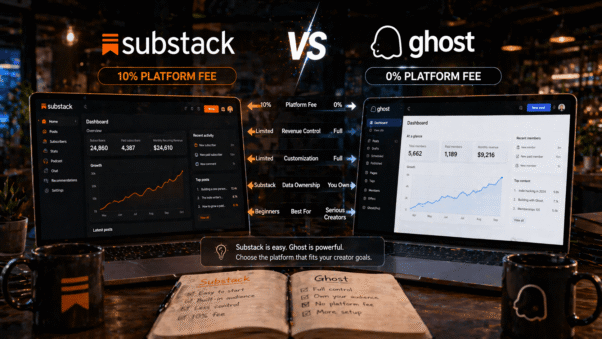
Ghost takes a very different approach. Ghost says it charges 0% transaction fees, and its managed plan starts at $18 per month billed yearly, while Stripe processing fees still apply. That makes Ghost a useful alternative when the newsletter grows and the creator wants stronger newsletter ownership with less platform cut. On bigger lists, the fee comparison gets very real, very fast.
| Platform | Platform cut | Processing fees | Ownership angle |
| Substack | 10% | Stripe fees | Simple, built-in network |
| Ghost | 0% | Stripe fees only | Stronger control and scale |
Beyond Paid Subs: The Full Monetization Stack
Sponsorships, affiliates, and product sales
The best Substack monetization strategies rarely stop at paid subscriptions. Strong newsletters also use sponsorships, affiliate links, and brand partnerships to widen the revenue stack. This works especially well when the audience trusts the writer and the niche has buying intent. A newsletter about software, finance, or business can monetize with more than one engine at once.
Coaching, courses, and digital downloads
If readers want help doing something, they may buy coaching offers, courses, or digital products. That is where direct monetization gets stronger than simple subscriptions. Free posts attract attention, paid posts create depth, and products turn expertise into higher-margin income. A smart content funnel does all three without making the newsletter feel like a used-car lot with better typography.
Newsletter Business vs. Substack Account Ownership
Platform dependence versus owned audience
A newsletter can live on Substack, but the business should belong to the creator. That means building an owned audience, not renting one from platform discovery. Substack says creators own their words and direct relationships, which is useful, but the creator still needs backup systems, email capture, and a clear retention strategy. A newsletter business guide should always separate the tool from the asset.
Why Ghost is a scaling comparison point
Ghost matters because it shows what happens when a creator wants more control over the subscription newsletter model. It offers independent publishing, a stronger business tool for owned media, and a clearer unit economics story at higher revenue levels. Substack is easier to start. Ghost is often better to scale. That is the whole Substack vs Ghost conversation in one sentence.
Growth Levers for U.S. Creators, from SEO to Referrals
Referral loops that reduce acquisition cost
Substack’s recommendation network is the hidden lever too many creators ignore. Since it drives a large share of new subscriptions, a smart referral program can accelerate audience growth without spending heavily on ads. This is especially important when you want referral growth and lower acquisition costs in a crowded market. The best creators treat recommendations like distribution, not decoration.
SEO pages that capture buyer-intent traffic
Search traffic works best when the page answers money questions. Phrases like how many subscribers to make $1,000/month, how many subscribers to make $5,000/month, and Substack newsletter income 2026 capture readers who already want a decision. That is classic SEO traffic with commercial intent, and it helps a newsletter become a real distribution engine instead of a hope strategy.
A practical case study
A creator starts with 800 free subscribers, writes one strong free essay each week, and turns on a paid tier after the audience understands the value. The free posts build trust, the paid tier delivers premium content, and one affiliate recommendation adds extra cash without distracting from the core offer. That mix is the kind of monetization breakdown that makes a newsletter resilient.
FAQs:
Is Substack worth it for new creators?
Yes, for most new creators it is worth testing because Substack is simple, fast to launch, and built around subscriptions. The real question is not whether it works, but whether you can build a clear offer, a loyal audience, and a plan for ownership before platform dependence gets comfortable.
How long does it take to reach $1K/month?
It depends on niche, pricing, and conversion rate. At $10 a month, you need roughly 100 paying subscribers for $1,000 in gross monthly revenue. The hard part is not the math, it is reaching a paid base that stays subscribed long enough to matter.
How many subscribers do I need to make $5,000/month?
At $10 per month, you need about 500 paying subscribers to hit $5,000 gross monthly revenue. After Substack and Stripe fees, the take-home amount is lower, so creators should track net revenue, not just gross numbers.
Is Substack better than Ghost?
Substack is better for speed, discovery, and simplicity. Ghost is better for lower fees and stronger ownership at scale. If you are early, Substack is easier. If your newsletter is becoming a serious business, Ghost often wins on margins and control.
What is the best paid newsletter pricing?
Most creators test monthly and annual plans around a simple, clear price point that feels easy to understand. The best pricing is the one your audience can justify through value, time saved, or money earned. Good pricing supports retention, not just the first sale.
Conclusion: Build a Newsletter Business, Not Just a Substack
Substack Newsletter Income 2026 rewards creators who think like business owners. The money comes from paid subscriber income, smart Substack monetization, lower churn, and a real newsletter business model that can survive platform changes. Substack is powerful, but the creator still has to do the hard part, build trust, create value, and keep the audience paying. The numbers only work when the offer does.
Take Action with PrimePulseLogic
PrimePulseLogic can help turn this into a real growth system, not just another content piece that looks busy and earns nothing. If you want a smarter Substack monetization guide, stronger SEO traffic, and a better path to take-home revenue, reach out through http://primepulselogic.com/ and use the contact form to start the conversation.